




Guide: A Guide to AI Search for B2C in 2026



Key Takeaways:
- AI search complements traditional search, it doesn't replace it.
Usage of traditional search platforms is still growing alongside AI search. Brands that earn visibility across both will pull ahead of those betting on one or the other. - Earning AI visibility requires the same fundamentals as strong SEO, plus a few new ones.
Clear, structured content, topical authority, and a strong offsite footprint (reviews, press, directories) are what drive citations in AI-generated answers. Schema markup and natural language content alignment are now table stakes. - Measurement needs to evolve alongside the channel.
Zero-click behavior means traffic metrics will undercount AI-driven impact. Branded search volume, direct traffic trends, and downstream CRM outcomes are more reliable signals than rankings or sessions alone.
Table of Contents

The search landscape has shifted significantly with the introduction of AI Overviews and LLMs (Gemini, ChatGPT, Claude, etc.). These major shifts have significantly expanded the opportunity with SEO and introduced a more focused AI Search Optimization, or GEO/AEO, depending on what you want to call it.
The conversation about AI search has been loud, but much of it has been wrong. Marketers have been told AI Search will make traditional search obsolete, or that it’s a shiny object not worth their time. Neither is accurate.
Datos’ Q1 2026 State of Search found that, despite the emergence of AI search platforms, traditional search platform usage continues to increase. The brands seeing success in today’s search landscape are focused on driving real visibility across search platforms.
This guide cuts through the noise and gives you a clear picture of:
- What AI Search actually is and how it works
- What it takes to earn visibility in AI generated answers
- How to measure whether your efforts are paying off, and the role of personalization
What AI Search Is and How It Works
AI Search platforms use LLMs (Large Language Models) to synthesize information from across the web and return a single, conversational response rather than a list of links. Instead of having to go to a website, users get an answer directly.
The most notable AI Search platforms include ChatGPT, Gemini, and Claude. However, it’s also important to note that Google’s AI Search stretches far beyond Gemini with AI Overviews & AI Mode. Google’s recent I/O update announced an update to allow users to more seamlessly interact with AI Overviews and AI Mode.
AI Search Impact on User Behavior
These changes to the search landscape have made it easier for users to research their options in order to make a decision. In many cases, this has significantly accelerated the decision making process and completely shifted brand discovery.
From an AI Search optimization standpoint, this plays out in a couple of major ways:
- Zero-Click Searches: AI answers have made it easy for users to get the information they were searching for, without ever having to go to a website. This has obvious measurement implications, making it difficult to prove value.
- Changing User Queries: Instead of the typical 2-3 word search queries, users are switching to a natural language approach. This has also caused a spike in “best of” searches as users conduct their research within a particular category. ChatGPT data shows users aren’t just asking for results, they are asking for help.
AI Search vs Traditional Search Results
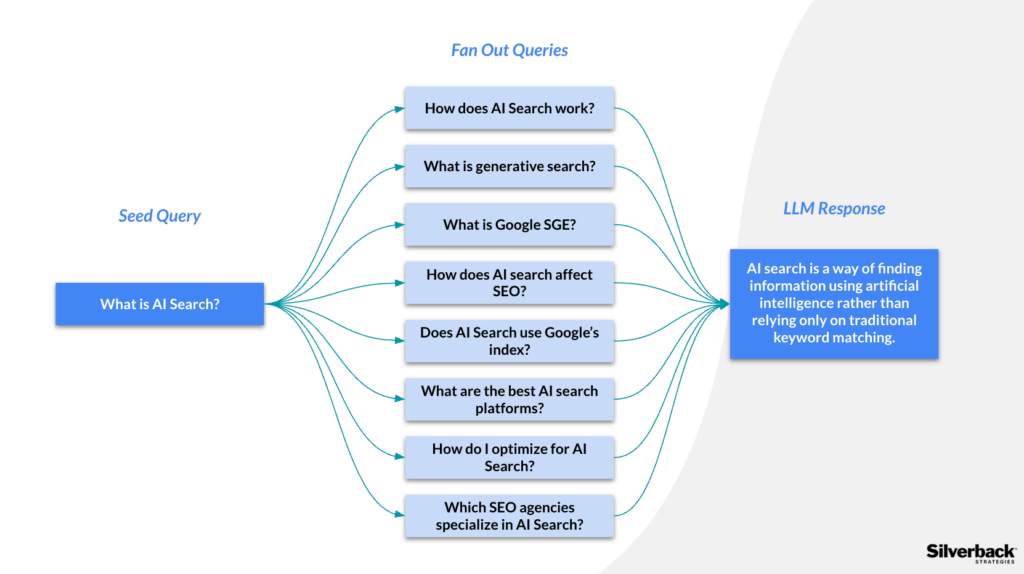
It’s important to understand the basics of how search results differ between the two. Traditional Search Engines operate on a one-to-one basis. Search engines look for one website on your website that most closely aligns with the search term. AI Search platforms can synthesize information from across your website into a single response.
This leads to what’s referred to as LLM Query Fanout. Essentially, LLMs go through a fanout research process to understand other related queries and questions in order to return a comprehensive answer. Below is an example of an LLM going through the query fanout process:
H3: How LLMs Decide What to Cite
Similar to SEO, AI Search is influenced by both onsite and offsite factors. When a model cites a source, it is signaling that the content was clear, credible, and relevant to the query at hand. There are several major factors that influence this:
- Content Clarity: Models favor content that is specific, organized, and directly answers the query.
- Topical Authority: Similar to SEO, models look for confirmation that you are an expert on a particular topic.
- Structure and Schema: Elements that make it easy for models to understand your content, who you are, and what you have to offer.
- Third Party Validation: External properties such as reviews, press mentions, industry directories, and even social/forum platforms (for example, YouTube & Reddit) all contribute to the picture a model builds of your brand.
What It Takes to Earn Visibility in AI Answers
Optimizing for AI Search is similar to SEO, but it also has some nuances and additional opportunities to be aware of.
Audience Aligned Content
AI models are built to answer questions. This starts with understanding how your audience’s questions are phrased in natural language, and it starts earlier in their decision journey. Instead of optimizing just for bottom funnel searches, understand the questions they are asking to know if they even have a problem.
Take your core target keywords and convert them into natural language AI prompts. Pair those prompts with your SEO-driven audience research to understand where the search opportunity meets potential business impact.
Structured Data Is No Longer Optional
Schema markup has always helped search engines understand your content, but this is amplified with LLMs. Search engines have the luxury of having decades of data to guide their models, but LLMs don’t have that, so they lean heavily into reliable signals.
When you implement clean, accurate, structured data across your site, including FAQ, Organization, LocalBusiness, Product, Review, etc., where applicable, you are making it easier for AI models to understand and extract your content accurately.
Build Your Offsite Footprint
As mentioned, AI models don’t just read your site, they read the entire web. That means your visibility in AI answers is partly determined by how your brand is represented offsite.
Brands with strong review profiles and meaningful mentions in authoritative publications are more likely to be cited favorably. This is not new territory for marketers, but the stakes have shifted. An AI model synthesizing “who are the best providers of X” is drawing from the same signals that have always shaped reputation. The brands with the strongest offsite footprint win that answer.
Each LLM also favors a different site of offsite sources. For example, YouTube has become the #1 sourced website for Google’s AI Overviews. These offsite sources vary by industry. Analyze your search landscape and determine where you need a presence.
Measuring The Impact of AI Search
Measurement with SEO has always been a challenge for many marketers, and these shifts have made it even more difficult. Many marketers have tried to solve SEO measurement challenges with keyword rankings and traffic. Neither of those is a business metric. Both can provide useful insight into visibility, but aren’t an indicator of business success. With AI Search, the connection between visibility and impact is even more blurred.
To effectively measure the impact of your AI Search efforts, you need a modern AI Search measurement playbook.
Measuring AI Visibility
With traditional search, measuring visibility is as simple as monitoring keyword rankings. With AI search, visibility is a combination of how often your brand is mentioned and how often your website is cited.
This isn’t as simple as it sounds, for several reasons:
- There are many popular AI search platforms, all with different models
- Many AI responses don’t mention brands or cite sources at all
- AI models are built for audience personalization
The Role of Personalization
AI search is meant to provide users with the most relevant information possible. As a result, AI models are designed with personalization in mind. LLMs will personalize AI responses based on what they know about you. This personalization can stem from a variety of areas:
- Conversation History: LLMs leverage previous conversations to guide future responses.
- Location: Geographic context is critical for local-specific results.
- Platform Access: Through Google’s Personal Intelligence, Google’s AI models allow users to connect their Gmail and Google Photos to increase relevance.
- Preferred Sources: Google also uses trust signals to personalize results with the platforms users care most about.
Understand Attribution Is Flawed
Because AI search often produces zero click interactions, session attribution data will not capture the full picture. If users are being introduced to your brand through AI answers, some portion will eventually show up in your site analytics, just not necessarily through your typical attribution lens.
AI-driven brand discovery tends to show up in downstream indicators, including branded search volume and direct/referral traffic. Establish baselines for branded query volume in Google Search Console and traffic trends within GA4.
Measuring Business Outcomes
Visibility is irrelevant if it’s not impacting your bottom line. Leverage your source of truth (ex. Salesforce, Hubspot, etc.) to establish a baseline across organic search, direct, and referral. As your visibility improves, do you see a measurable increase in business outcomes?
Your CFO isn’t going to sign off on AI search investments based on traffic or visibility. You need to showcase the impact on the business itself.
Putting an AI Search Strategy into Action
A successful AI search strategy in 2026 is nimble. The landscape is changing at an incredibly fast pace, and the brands that are successful are the ones that aren’t afraid to take big swings. Establishing the right approach can be a lot to tackle.
If you’re unsure where to start, we would be happy to walk you through it. Contact our team to have a custom 90-day roadmap put together.
FAQs
Is AI search replacing Google and traditional search engines?

No. Traditional search platform usage is still growing alongside AI search. However, how users are using traditional search engines is changing as they adopt AI search. The brands seeing the most success in 2026 are building visibility across both, not abandoning one for the other.
What is AI Search Optimization, and how is it different from SEO?
AI Search Optimization (also called GEO or AEO) is the practice of earning visibility within AI-generated answers from platforms like ChatGPT, Gemini, and Google's AI Overviews. It builds on traditional SEO fundamentals like topical authority and structured content, but adds new components, particularly around offsite brand representation.
What factors influence whether an AI model cites my brand?
AI models favor content that is specific, well-organized, and directly answers the query. Beyond your website, they also weigh your offsite footprint, including review profiles, press mentions, industry directories, and presence on platforms like YouTube and Reddit. The stronger your onsite and offsite signals, the more likely you are to be cited.
Do I need schema markup to show up in AI search results?
Structured data isn’t necessary, but it can be very beneficial. Schema helps AI models accurately understand and extract your content. Implementing the right schema across your site, where applicable, gives LLMs reliable signals to work with and increases your chances of being cited.
How should I measure the business impact of AI search?
Start by establishing baselines in your CRM (Salesforce, HubSpot, etc.) across organic, direct, and referral channels. As AI visibility improves, track whether downstream business outcomes, including leads, pipeline, and revenue, move in the same direction. Visibility metrics are a useful proxy, but business outcomes are the only measurement your CFO will care about.