



Blog: YouTube is the #1 Source for Google AI Overviews: Is Your SEO Strategy Ready?



Last updated on July 8, 2026
Key Takeaways
YouTube is the most cited website in Google’s AI Overviews, cited up to 30% of the time.
YouTube’s impact is model dependent. ChatGPT and Gemini rarely cite YouTube in comparison.
Organic success requires a modern SEO playbook revolving around audience research to meet users across channels throughout their journey.
Table of Contents

In the AI Search landscape, the name of the game is being part of the response. With that, everyone is competing to be cited as a source for the answer.
That’s becoming increasingly challenging, given how often LLMs are sourcing third-party websites, such as Reddit and now YouTube.
In addition to being the second most visited website in the world, behind only Google, it’s also now the #1 most sourced website within Google’s AI overviews.
YouTube’s Dominance of AI Overviews
According to recent BrightEdge data, YouTube has become the most commonly cited website within Google’s AI Overviews. The data found that AI Overviews cited YouTube up to 30% of the time, compared to Vimeo’s 0.1%. When you factor in how often AI Overviews appear, which is now over 50% of queries, this presents quite the opportunity.
It’s not just how often YouTube is being cited; it’s also the shift in the types of searches that YouTube is being cited for. YouTube is often seen as upper funnel, but it’s being cited for searches throughout the funnel, including high intent terms.
YouTube Citation Study
As part of our AI measurement playbook, we actively track hundreds of AI prompts aligned with our clients’ target audiences to measure visibility and the sources driving that visibility.
With this data, we put together an aggregate study that looks at how influential YouTube is across core AI search models. Across our portfolio, YouTube is the second most influential 3rd party website, only behind Reddit. However, as you peel back the layers, you can see that YouTube’s influence is almost solely driven by Google’s AI Overviews.
For this study, Silverback analyzed over 10,000 AI responses to prompts across our portfolio and found that YouTube was cited over 10% of the time, in aggregate across multiple LLMs, including ChatGPT, AI Overviews, and Gemini. Across all of the AI responses where YouTube was cited, 65% of those citations occurred within Google’s AI Overviews, compared to only 7% for Gemini and 1% for ChatGPT.
The gap between AI Overviews & Gemini is surprising given these models & YouTube all reside within Google’s ecosystem. This is a great indicator that all models should be analyzed independently, because the factors contributing to visibility vary greatly.
Why YouTube
Similar to optimizing for YouTube search, AI Search is influenced by a video’s title, description, tags/categories, playlists, etc. In addition, AI models can “watch” and “listen” to video transcripts to understand the content within the video itself.
As a result, this type of content makes it easier for Google to confidently source YouTube videos within AI Overviews because they can easily answer queries like “how to” or “how much,” for example.
What Does This Mean For Your SEO Strategy
In today’s AI Search landscape, it’s easier than ever to start your journey with brand discovery and make a quick decision, so being part of the conversation is everything. With YouTube’s dominance of AI Overviews, in order to be part of that conversation, you need to consider the role of YouTube.
If video isn’t a part of your current strategy, determine whether or not it should be based on where your audience spends most of their time. Using an audience research tool like SparkToro, you can get a sense of what search and social platforms your audience typically uses.
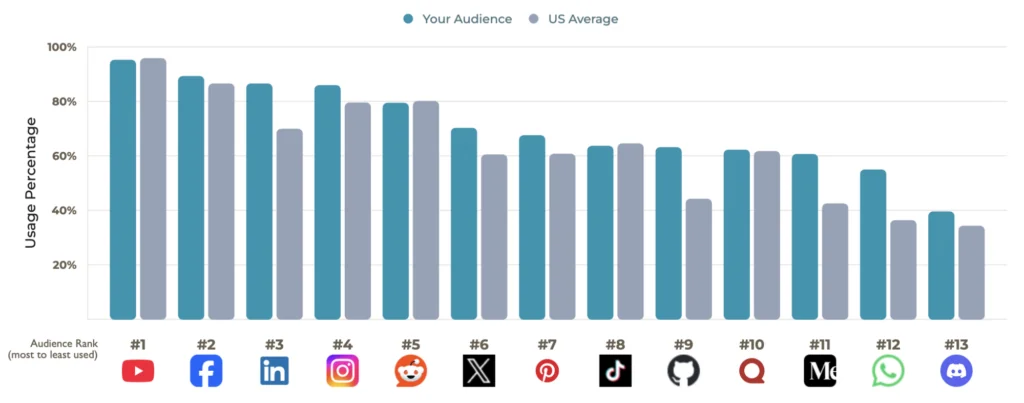
Between search engines, LLMs, and social platforms, organic search is everywhere. In order to ensure your brand is as well, you need a modern SEO playbook.
- Audience Research: It all starts with understanding your target audience and how it relates to SEO. Where is your audience searching for a solution? What social platforms are they using to research their options? What type of content are they looking for at each stage of their journey?
- Content Strategy: With an understanding of what platforms your audience is on and the type of content they are looking for, the content strategy becomes clear. Consumer journeys are complex, typically across multiple channels, so your content strategy needs to meet your audience where they are.
- Measurement: A modern SEO playbook requires modern SEO measurement. Organic Traffic & rankings are no longer sufficient on their own. In today’s AI Search landscape, you also need to measure how often you are mentioned and cited. How does your AI Search share of voice compare to your competitors? As your visibility improves, keep a close eye on direct and referral traffic and conversions.
Bottom line, the search landscape is evolving, and your SEO strategy needs to keep up, shifting from chasing rankings and organic traffic to understanding visibility across channels and the impact on driving real business growth.