



Blog: ChatGPT Has a Billion Users. Most of Them Aren’t Shopping. Here’s What That Means for Marketers.



Last updated on August 18, 2026
Key Takeaways
- ChatGPT is a personal assistant, not a product finder (yet):
Only 2% of ChatGPT conversations are about purchasable products. People are using it to learn, write, and get advice. That's the behavior marketers need to understand before building a strategy around it. - The search intent on ChatGPT is fundamentally different from Google:
On Google, 53% of queries are informational. On ChatGPT, 38% are generative. People aren't looking for a link, they're looking for an outcome. That changes what "showing up" means. - Google isn't going anywhere:
95% of ChatGPT users also use Google. Google still owns high-intent, lower-funnel purchase behavior. The smart play is building visibility on both, not abandoning one for the other. - Being helpful is now a distribution strategy:
How-to content, FAQs, and structured answers aren't just good SEO. They're how you get cited in AI responses. The brands that get this right will have a compounding advantage. - Community and third-party content matter more than ever:
AI pulls from Reddit, forums, and review sites. If your brand isn't showing up in those conversations, you're not showing up in AI answers either.
Table of Contents

The Number That Should Get Every Marketer’s Attention
ChatGPT just became the fastest app in history to reach 1 billion monthly active users. For context: it took Instagram six years to get there. ChatGPT did it in just over two.
And of the 2.5 billion prompts flowing through ChatGPT every day, only 2% are about purchasable products.
Two percent.
That’s not a channel built for bottom-of-funnel conversions. Not yet, anyway. What it is, is a platform where nearly a billion people are asking for help. They’re having conversations, not clicking ads. And that behavior shift has implications for every marketer who’s spent the last decade optimizing for search intent.
The question isn’t whether ChatGPT matters. It clearly does. The question becomes, ‘how does ChatGPT build visibility for our brand?’
What People Are Actually Doing on ChatGPT
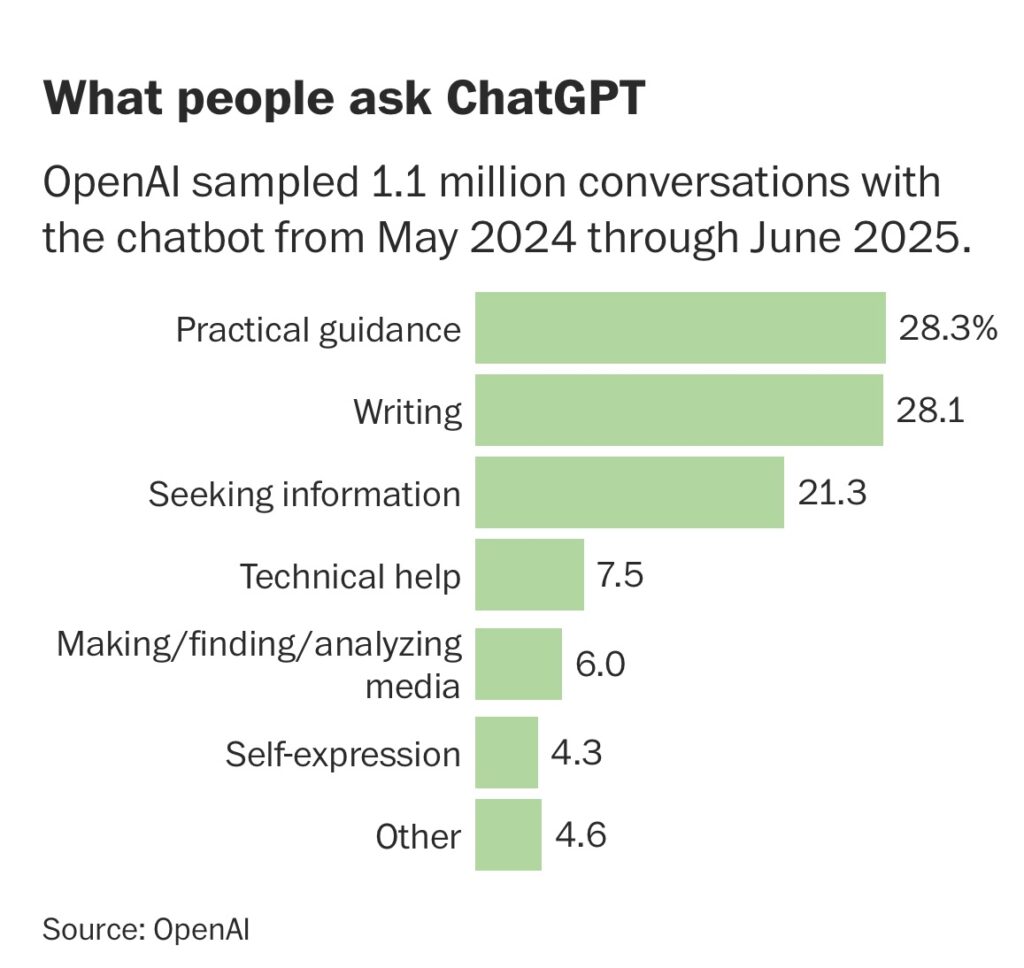
The usage breakdown tells the story more clearly than the user count does. Of all ChatGPT conversations:
- 28% are practical guidance — how-to help, health questions, self-care
- 28% are writing support — drafting, editing, refining
- 21% are information-seeking — “How do I bake sourdough bread at home?”
- 2% are about purchasable products
Plus, the intent on ChatGPT is structurally different from Google. A study analyzing over 50 million ChatGPT prompts found that 38% of ChatGPT queries are generative. People aren’t looking for a list of links to click, they’re looking for an outcome delivered directly.
Navigational intent, which makes up 32% of Google searches, collapses to just 2% on ChatGPT. People aren’t using it to get somewhere. They’re using it to get something done.
Meanwhile, the queries themselves are getting longer and more conversational. ChatGPT’s internal search queries average 5.5 words, which is 61% longer than Google’s average of 3.4 words.
People are typing to ChatGPT the way they’d talk to a colleague. “What are the best home services companies doing differently in their paid media right now?” is a ChatGPT query. “Home services paid media” is a Google query. Same topic. Completely different behavior.
Reading Between the Lines
This is a behavior shift.
People aren’t moving from Google to ChatGPT the way they moved from desktop to mobile. They’re using ChatGPT for different things entirely. Google is where you go when you know what you want and you’re ready to act on it. ChatGPT is where you go when you’re still figuring it out.
That distinction matters a lot for where marketing dollars work. Upper-funnel behavior — awareness, consideration, information-gathering — is increasingly happening on AI platforms. Lower-funnel, high-intent purchase behavior still lives on Google.
The data backs this up: 95% of ChatGPT users also use Google. These aren’t competing tools for the same job. They’re different tools for different parts of the journey.
The marketing implication: brands need visibility on both, and marketers need to understand what “visibility” means differently on each. On Google, you show up in results. On ChatGPT, you get cited in answers. Those require different things.
One more signal worth watching: shopping queries on ChatGPT doubled in the first half of 2025, and click-through rates from ChatGPT responses tripled between March and June of the same year. The platform is still early-stage for commerce, but the trajectory is clear. The brands building presence there now are going to have a compounding advantage as that behavior matures.
What This Means for Marketers
Think about “showing up” differently on each platform
On Google, you optimize for keywords and earn rankings. On ChatGPT, you earn citations. The path to being cited in an AI response is being the most useful, clearly structured, directly answering source on a topic. That means FAQs, how-to content, and content that answers a specific question completely rather than gesturing at it. If your content is vague enough that a human couldn’t act on it, an AI won’t cite it either.
Be the helpful guide, not the sales pitch
People asking ChatGPT for practical advice don’t want to be sold to. They want to be helped. The brands that show up in AI responses are the ones that made themselves genuinely useful upstream of the purchase decision—guides, calculators, tools, direct answers. That content influences what the AI recommends. And what the AI recommends influences what people buy, even when the conversation wasn’t about buying.
Get serious about third-party presence
A study of 20,000 ChatGPT product recommendation responses found that product recommendations changed 80% of the time when web search was enabled versus disabled. What was in the cited sources shaped what got recommended. Reddit, review sites, forums, and third-party content are no longer just reputation management channels. They’re distribution channels for AI visibility. If your brand isn’t showing up in those conversations, it’s not showing up in the answers.
Don’t abandon Google
This is the part that gets lost in the AI search conversation. Google still owns the moment when someone knows what they want and is ready to act. High-intent, lower-funnel purchase behavior hasn’t moved. What’s moved is the discovery and consideration phase that precedes it. A strategy that over-indexes on AI visibility at the expense of Google presence is leaving money on the table at exactly the moment a customer is ready to spend it.
Watch the shopping behavior closely
The 2% product conversation figure is a current snapshot, not a ceiling. ChatGPT launched a dedicated shopping feature in late 2025. Shopping queries are growing fast. The brands that understand how AI product recommendations work—and optimize for them now—are positioning themselves for a significant channel before it gets crowded. That’s the same logic that made early investment in Google Shopping, Facebook ads, and Amazon search valuable. Early presence in a new channel compounds over time.
The Bottom Line
A billion people are now using ChatGPT every month. They’re mostly not shopping. They’re learning, writing, asking, figuring things out. And somewhere in that behavior is a version of almost every customer journey your brand cares about.
The brands that figure out how to be useful at that stage—before intent is clear, before someone heads to Google ready to buy—are going to have a meaningful advantage over the ones who wait for the behavior to be fully legible before they act.
The playbook is early. The direction is clear. Start building visibility now.
Contact us today to learn more
Frequently Asked Questions
Should I optimize for ChatGPT instead of Google?

Not instead of — in addition to. 95% of ChatGPT users also use Google, and Google still dominates high-intent, lower-funnel search behavior. The smarter framing is that different platforms own different parts of the customer journey: ChatGPT is increasingly where discovery and consideration happen, Google is still where purchase intent lands. A strategy that ignores either one leaves significant visibility on the table.
How do I get my brand mentioned in ChatGPT responses?
The short answer: be the most useful, clearly structured source on a topic. ChatGPT cites content that directly and completely answers a question — FAQs, how-to guides, structured content with clear headers and direct answers. It also pulls heavily from third-party sources: Reddit, review sites, forums, and independent publications. Brand mentions in those spaces influence what AI recommends, sometimes more than your own website.
What is GEO and how is it different from SEO?
GEO stands for Generative Engine Optimization, the practice of optimizing content to appear in AI-generated responses rather than traditional search rankings. Traditional SEO focuses on keyword targeting and backlink authority to earn Google rankings. GEO focuses on content structure, directness, and third-party credibility to earn citations in AI answers. The two disciplines overlap significantly, but GEO requires thinking about "being cited" rather than "ranking" as the primary visibility metric.
Is ChatGPT a threat to organic search traffic?
It depends on your content mix. Informational content — how-to guides, explainers, FAQs — is most at risk, because ChatGPT answers those questions directly without sending traffic to your site. Transactional and navigational content is more insulated for now. The practical response is building content that earns citations in AI responses (which can drive referral traffic) while continuing to optimize for high-intent Google queries where click-through behavior remains strong.
How quickly is ChatGPT growing as a search tool?
Quickly. ChatGPT crossed 1 billion monthly active users in June 2026 — the fastest any app has reached that milestone. Shopping queries on the platform doubled in the first half of 2025. Click-through rates from ChatGPT responses tripled in the same period. The platform is still early for commerce, but the trajectory suggests that brands building presence now will have a meaningful head start when shopping behavior on AI platforms matures.