




Blog: Scaling Offline Conversions: A 2026 Guide to Paid Media for Lead Gen Brands


Key Takeaways
- In lead gen, the ad platform declares victory long before your business makes money.
The time between a form fill and a new customer is where most paid media budgets leak. - Set cost per lead and customer acquisition cost targets from your own unit economics.
If your targets aren't built on margin, average order value, and lifetime value, you're optimizing toward a number nobody can defend. - Automated bidding is only as good as the conversions you send it.
If your conversion signal includes leads your sales team would reject, you're paying Google and Meta to find more of them. - Budget for the work that isn't media.
Plan on 10-20% of paid budget for structured testing and a separate line for creative production. These are easy budgets to cut, but the most difficult to rebuild. - Demand creation channels won't look efficient in a last-click report.
Fund them against incremental value, and prove that value with lift studies rather than defending it with attribution models.
Table of Contents

Why Lead Gen Paid Media Needs Its Own Playbook
Most paid media advice is written for ecommerce. Someone clicks, buys, and the platform sees the revenue in minutes. The feedback loop is nearly instant and the conversion the platform counts is the same conversion the business counts.
Lead gen doesn’t work that way. If you’re a home services company, a law firm, a senior living community, a university, or an insurance brand, your sale closes on a phone call, in a consultation, or in a CRM record weeks later. The platform never sees it unless you send it back.
That single difference changes almost everything downstream: which conversion actions you optimize toward, how you set targets, how you structure campaigns, how much conversion volume your bidding strategy actually has to work with, and how you prove any of it worked.
This guide covers how to run paid media when the sale happens offline:
- What the offline conversion gap is and how to size yours
- The mistakes we see most often in lead gen accounts
- How to set CPL and CAC targets from your actual economics
- How to allocate budget across demand capture and demand creation
- How to structure campaigns so AI bidding works in your favor
- How to measure incrementality when you don’t have ecommerce-scale volume
What Is the Offline Conversion Gap?
The offline conversion gap is the distance between the moment an ad platform records a conversion and the moment your business actually earns revenue.
It has two dimensions, and you need to size both.
- Channel gap: where the conversion happens. The real conversion occurs somewhere the pixel can’t reach — a phone call, a walk-in, a rep-entered CRM record, a signed paper contract. In phone-heavy verticals, this can account for the majority of qualified pipeline.
- Time gap: when the conversion happens. Even when you can eventually see the outcome, it lands long after the platform made its bidding decisions. In the accounts we manage, lead-to-sale lag routinely runs from a few days to a few months — and it moves seasonally. One education client we work with sees a 70-day average lag for leads generated in September and a seven-day lag for the same programs in April, with most of the media budget spending during the 30–40 day window in between.
That timing matters because automated bidding won’t wait. As a rule of thumb, Google’s smart bidding wants somewhere around 30 conversions in a 30-day window to optimize with confidence. If your real outcome takes 60 days to appear, the algorithm optimizes against the only signal available in time — the form fill — and gets very good at producing form fills.
How to size your own conversion gap:
- Pull your last 12 months of closed revenue and tag each record with its original source.
- Calculate the median days from first touch to closed sale, by month. Don’t use the average alone; seasonality will hide in it.
- Calculate what share of closed deals originated from a channel your ad platforms can see (form fill with a click ID attached) versus one they can’t (untracked call, walk-in, referral).
- Compare platform-reported conversions to CRM-qualified leads for the same period.
Those four numbers tell you how much of your paid media performance is currently invisible to the systems making your bidding decisions.
The Mistakes We See Most Often in Lead Gen Accounts
Optimizing toward a lead your sales team wouldn’t accept. Every conversion you send back to Google or Meta is a training example. It’s common for us to inherit accounts where sales rejects half or more of the leads the platform is being trained on. The algorithm isn’t malfunctioning — it’s learning exactly what you taught it.
Setting CPL targets by habit. Most targets we inherit were built by taking last year’s number and shaving off 10%. That’s a budget ritual, not a target. It also means nobody in the room can say what a lead is actually worth.
Chasing a falling cost per lead. The cheapest leads in any account are usually the least qualified: people early in research, outside your service area, or price-shopping. A CPL that drops sharply without a corresponding revenue increase is a warning, not a win.
Judging demand creation on last-click. Paid social, CTV, and YouTube rarely win a last-click report. Evaluating them the same way you evaluate branded search guarantees you’ll underfund them, and then wonder why branded search volume is flat.
Treating tracking as an IT ticket. Offline conversion tracking gets scoped as plumbing, assigned to whoever has CRM access, and never finished. In our experience it’s the highest-leverage work in most lead gen accounts and it’s almost always the thing that’s been open longest.
Splitting budget across too many channels too early. Below a certain spend per channel, you don’t have enough conversion volume for bidding to learn or for tests to read. Three channels funded properly beat six funded thinly.
How to Set CPL and CAC Targets From Your Actual Economics
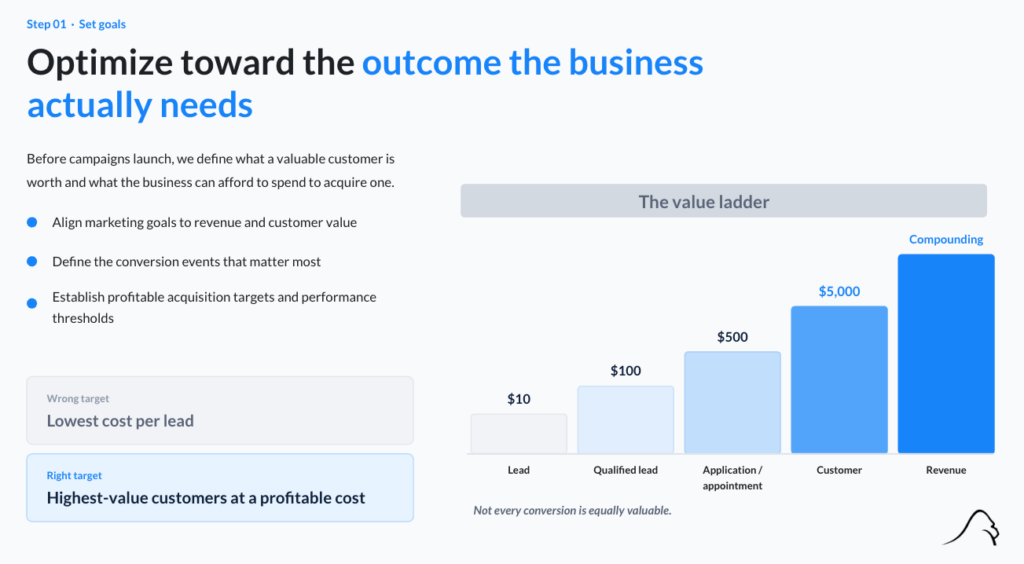
Your cost per lead and customer acquisition cost targets should be derived by working backward from what a customer is worth.
The inputs you need:
- Average order value (AOV) or average contract value
- Gross margin after cost of goods sold
- Customer lifetime value (LTV) if you have repeat purchase or renewal
- Lead-to-sale close rate, by source if possible
- Target payback period — how long you’re willing to wait to recover acquisition cost
The calculation:
- Start with gross profit per customer (AOV x margin, or LTV x margin for recurring revenue).
- Decide what share of that profit you’re willing to spend to acquire the customer. That’s your maximum CAC.
- Divide maximum CAC by your lead-to-sale close rate. That’s your maximum CPL.
- Establish incremental CAC targets based on incrementality benchmarks by media channel and tactic.
How to Allocate Budget Across Demand Capture and Demand Creation
Demand capture harvests intent that already exists – branded and non-brand search, Performance Max, Local Services Ads. Demand creation builds intent that doesn’t exist yet – paid social, YouTube, CTV, display.
Fund capture to saturation first. It’s the shortest path to revenue and gives you the conversion volume everything else depends on. Once demand capture is saturated, additional budget there produces diminishing returns, and the next dollar is better spent creating demand.
A workable starting budget split for lead gen brands:
- 60-75% demand capture while you’re establishing baseline performance
- 25-40% demand creation, scaling as you can demonstrate incremental value
- 10-20% of total budget earmarked for structured testing, which sits across both demand capture and creation.
Every channel has an incrementality rate: the share of its reported conversions that genuinely wouldn’t have happened without the ad exposure. Don’t invest in any channel or tactic beyond its specific incremental value to your business. Doing so gives a channel credit for leads or sales that would have been captured without spending that advertising dollar.
Watch for saturation signals in capture:
- Impression share above roughly 80% on your core terms with rising CPCs
- Non-brand conversions flattening while spend climbs
- Increasing overlap between branded search and other channels’ claimed conversions
How to Structure Campaigns So AI Bidding Works in Your Favor
Automated bidding isn’t optional anymore. Performance Max, Advantage+, and smart bidding have absorbed many of the platform levers that used to be manual. What advertisers still control is the inputs.
Consolidate enough to reach volume. Bidding algorithms need conversion density to operate effectively. Over-segmented accounts (e.g. a dedicated campaign per program, per location, per product line) split volume until no single campaign has enough data to allow the machine learning to optimize. In Silverback’s account audits, over-segmentation is one of the most common structural problems we find, and consolidation is usually the fastest performance improvement available.
Optimize toward hard conversions that are directional to revenue. Rank your conversion actions by how well they predict revenue:
- Hard conversions: qualified lead, booked consultation, connected sales call, application submitted
- Soft conversions: form fill, content download, chat initiated, phone click
- Noise: page views, video views, bot submissions
Soft conversions are useful as secondary signals and as volume when you’re below bidding thresholds. They shouldn’t be your primary optimization target once you have the volume to avoid it.
Use value-based bidding. Lead types or funnel stages vary in value to a business. For example, a phone call may be worth $20, where a set appointment is worth $100. That’s a 5x value differential. Send lead values back into ad platforms—either as a proxy or as actual values once you have enough conversion volume to do so—to direct ad algorithms toward the most profitable leads.start generating higher signal volume This is often the highest-return change available in mature accounts.
Defend against junk conversions. Soft conversions and noisy engagement metrics are easily replicable by bots. Optimizing toward these soft conversion signals in Google or Meta welcomes significant wasted media spend on conversions that aren’t real. Bot form fills and low-intent submissions inflate your conversion count and poison your training data. Practical defenses against bots include: CAPTCHA or equivalent on forms, qualification questions that add just enough friction, honeypot fields, and use of a bot tracking tool like FouAnalytics to assess bot activity over time.
Add friction on purpose where it helps. Putting pricing on a landing page will raise your CPL and improve your lead quality, because it disqualifies people before they submit. That’s a good trade in most lead gen businesses, and it’s an uncomfortable one to explain if your scorecard only tracks CPL.
How to Close the Offline Conversion Loop with Ad Platforms
This is the technical work that drives in-platform optimization. It’s unglamorous and it moves performance more than most campaign changes. Clean offline conversion data tells Google and Meta which clicks turned into revenue so their bidding can chase more of them. It does not tell you whether a channel deserves its budget – that’s an incrementality question, and we’ll get to it next.
- Capture the click ID on arrival. Google’s GCLID and Meta’s equivalent need to be captured in a hidden form field on every lead form and stored on the lead record.
- Configure call tracking to pass the click ID. Dynamic number insertion should tie the call back to the session that produced it, and that identifier needs to reach the CRM, not just the call tracking dashboard.
- Define your lead stages and make them exportable. You need agreed definitions for each stage — e.g. new lead, qualified, appointment set, closed — and they need to be used consistently by your sales team.
- Export outcomes back to the ad platforms. Both Google and Meta support offline conversion imports. Set a regular cadence rather than a one-time upload.
- Pick a leading indicator you trust. If your true outcome lands outside the bidding window, find the mid-funnel milestone that best predicts it and optimize toward that.
Common failure points to check first:
- Click ID field exists on the form but isn’t mapped to the CRM field
- Call tracking captures the call but not the source session
- Lead stages are defined differently by marketing and sales
- Conversion actions in Google are set to “secondary” and never promoted to primary
- Nobody owns the export, so it runs once and stops
What Is Incrementality Testing, and When Can You Actually Use It?
Incrementality is the share of your results that your advertising actually caused.
The test for it is straightforward: withhold advertising from a comparable test group (i.e. a set of geographies or a slice of audience), run the campaign in the control group, and compare results. If you pause branded search in five states for six weeks, while keeping it on in five others, and revenue there holds steady – you’ve learned something no platform dashboard will tell you. Brand Search is taking credit for leads that you would have captured without the advertising expense.
When incrementality testing works:
- You have enough conversion volume in both test and control groups to detect a real difference
- You can isolate geographies that are genuinely comparable
- You can tolerate a test period of roughly four to eight weeks
- The channel being tested represents at least 5% of your overall marketing budget.
When it doesn’t:
Incrementality testing has a volume floor. High-ticket lead gen businesses closing dozens of deals a month rather than thousands often can’t clear it, and running an underpowered test is worse than running none – you’ll get a result, but you can’t trust it.
What to do if you’re below the threshold:
- Close the offline conversion loop first. Get real outcomes into ad platforms to generate higher signal volume at earlier funnel stages.
- Run holdouts or flighted on/off tests on your highest-volume channels. Prioritize tests based on where your marketing budget is most concentrated (and likely generating some waste), or where there are significant differences between attributed platform performance and benchmark incremental returns.
- Revisit as volume grows. The threshold isn’t permanent.
Creative, AI, and Micropersonas
When the ad platform controls bidding, placement, and targeting, creative becomes a primary lever for fueling performance. It’s one of the main inputs you still fully own on media channels like Meta. That shift wasn’t a choice the platforms made lightly – signal loss from iOS 14.5, cookie deprecation, and tightening privacy regulation forced Meta and others to rebuild their ad delivery systems around broad targeting and algorithmic discovery. The practical consequence: your creative is now the targeting.
AI production tools now make it practical to build creative variations at scale, which means you can meaningfully address narrow audience segments instead of aiming one message at everyone.
How to effectively use AI to fuel creative production:
- Build creative for specific micropersonas: the parent of a fifth grader, the adult child researching care for a parent, the homeowner with a failing system — rather than generating more versions of the same generic ad
- Anchor each persona in a real purchase motivator or barrier, not a demographic bracket
- Test message themes first, then production formats
- Refresh against ad fatigue signals and performance creative systems rather than on a fixed calendar
Where to be careful with AI: Generating people or scenarios that misrepresent your product tends to read as inauthentic and can trigger platform policy issues in regulated verticals. Using AI for production efficiency — background swaps, resizing, versioning, localization — is lower risk and usually where the actual time savings are.
Budget for creative testing velocity. Creative production is often a separate line from media. Accounts that don’t fund creative testing end up with a well-funded media plan running tired assets.
How to Start With Paid Media in 2026
If you’re rebuilding a paid media program around real business outcomes, build in this order:
- Establish reality with your CPL and CAC targets. Ground both in your actual economics — cost of goods sold, average order value, and customer lifetime value. Calculate an allowable CPL per channel based on that channel’s close rate, not one blended number.
- Set the foundation on demand capture, then build demand deliberately. Fund Google Search, Performance Max, and other capture channels to saturation. Then build net-new awareness on mid- and upper-funnel channels, but don’t invest in any tactic beyond its specific incremental value to your business.
- Build a campaign structure that fuels ad algorithms without misleading them. Consolidate enough to give bidding the conversion density it needs, then optimize toward hard conversions and value rather than whatever action is easiest to replicate. Keep bot traffic and low-intent submissions out of your conversion set.
- Activate AI with creative built for tailored micropersonas. Use production capacity to address specific segments with specific messages, not to produce more variations of a generic one.
- Scale through measurement, testing, and creative strategy. Maintain a testing cadence you actually keep, run incrementality tests where volume allows, and report performance in terms of revenue and profit rather than platform-attributed conversions.
If you’re not sure where your paid media strategy stands, contact our team and we’ll build you a 90-day roadmap based on your goals.
Frequently Asked Questions
Why don't my Google Ads conversions match my CRM?

They're counting different things at different times. Google counts a conversion when the tracked action fires — usually a form submission — and credits it to the click that produced it within its attribution window. Your CRM counts a record when someone enters or qualifies it, often days later, and frequently after a phone call the pixel never saw. Some gap is normal. A large or growing one usually means offline conversions aren't being imported, or your conversion action is firing on something sales wouldn't call a lead.
What is an offline conversion and how do I track it?
Any business outcome that happens away from your website — a phone call, a consultation, a signed contract, a CRM stage change. To track it: capture a click identifier like Google's GCLID when the lead arrives, store it on the CRM record, and send the outcome back to the platform when it happens. Both Google and Meta support this. The hard part is almost never the platform side; it's getting the click ID reliably onto the lead record.
What's a good cost per lead for lead gen?
There's no universal benchmark, and any number you see quoted is averaging across businesses with completely different economics. Calculate your own: gross profit per customer, times the share you're willing to spend to acquire them, divided by your lead-to-sale close rate. Do it per channel, because close rates differ by source.
Should I optimize toward leads or qualified leads?
Qualified leads, if you have enough volume — roughly 30 conversions in 30 days is the common threshold for smart bidding. Below that, optimize toward a mid-funnel action that predicts qualification, like a connected call or a booked appointment, rather than the raw form fill.
What's the difference between attribution and incrementality?
Attribution divides credit among touchpoints a platform can see. Incrementality measures what your advertising actually caused, by comparing against a group that didn't receive it. When they disagree, incrementality is the number to use for budget decisions.
How much should I budget for paid media testing?
10-20% of media budget should be earmarked for creative, bidding and new platform testing. The specific budget figure matters less than protecting it.
How long should an offline conversion lag be?
It depends on your business, and it shifts seasonally, so measure it rather than assuming. In seasonal accounts we manage, the same program can show a 70-day lag in one month and a seven-day lag in another. Knowing your lag by month and service/product is what tells you whether your reporting window is showing a complete picture.
Can small advertisers run incrementality tests?
Only above a certain conversion volume. Below it, the test won't have the statistical power to detect a real effect and you'll get a number that means nothing. Start with a branded search holdout, blended reporting, and a leading indicator, and revisit as volume grows.