




Blog: What Separates Winning Paid Social Accounts From Stalled Ones: A Creative System


Last updated on June 1, 2026
Key Takeaways
- Meta's algorithm shift made creative the primary lever in paid social —
replacing the audience targeting levers data privacy laws took away. Most teams adapted by testing more volume. That's no longer enough. - The teams winning on paid social now have built creative systems, not just creative volume.
The foundation is a tagging taxonomy: every ad classified across concept, format, key message, persona, and funnel stage before it goes live. - A creative system requires four things in place at once:
audience insight, true concept diversity, enough volume for patterns to surface, and a production process that can keep up. Miss one and the system breaks down into expensive guesswork.
Table of Contents

There’s a phrase that’s been running through paid social conversations for the last couple of years: creative is the new targeting. It’s true. It’s also been repeated enough that most marketers nod along without doing anything different.
The reason it matters is structural. When data privacy legislation cut off the flow of browsing and app behavior into ad platforms, the targeting layer that paid social was built on collapsed. Meta rebuilt its ad serving system around what it could still see: the ad itself and how users responded to it. The algorithm now reads the creative to figure out who should see it. The hook, the format, the person on screen, the message — those are the signals the platform uses to decide who’s likely to convert.
That shift happened years ago. The accounts that have adjusted to it are pulling ahead. The accounts that haven’t are running paid social the way they ran it in 2019 and wondering why performance keeps slipping.
How paid social creative testing has evolved (and where most brands are stuck)
The industry’s response to the algorithm shift has come in stages, and a lot of brands are still operating in the wrong one.
The first stage was running more tests. Find a winner, declare it, move on. The second stage narrowed the focus to the opening seconds of an ad. Swap the hook, hold everything else constant, see what wins. That became the default playbook across most paid social accounts and still is for many of them.
The third stage was real creative diversity. Different formats, different messages, different visual approaches all running at once. That works better than the prior playbooks, because it gives the algorithm more to learn from. But on its own, diversity produces a top-performing ads list. It doesn’t produce understanding of why the top performers are working, which means there’s no clear way to scale what’s winning.
The accounts driving the strongest performance right now have gone one step further. They’ve turned creative into a system. The heart of that system isn’t volume or velocity, though both matter, it’s a tagging structure that turns every ad into a data point in a learning model.
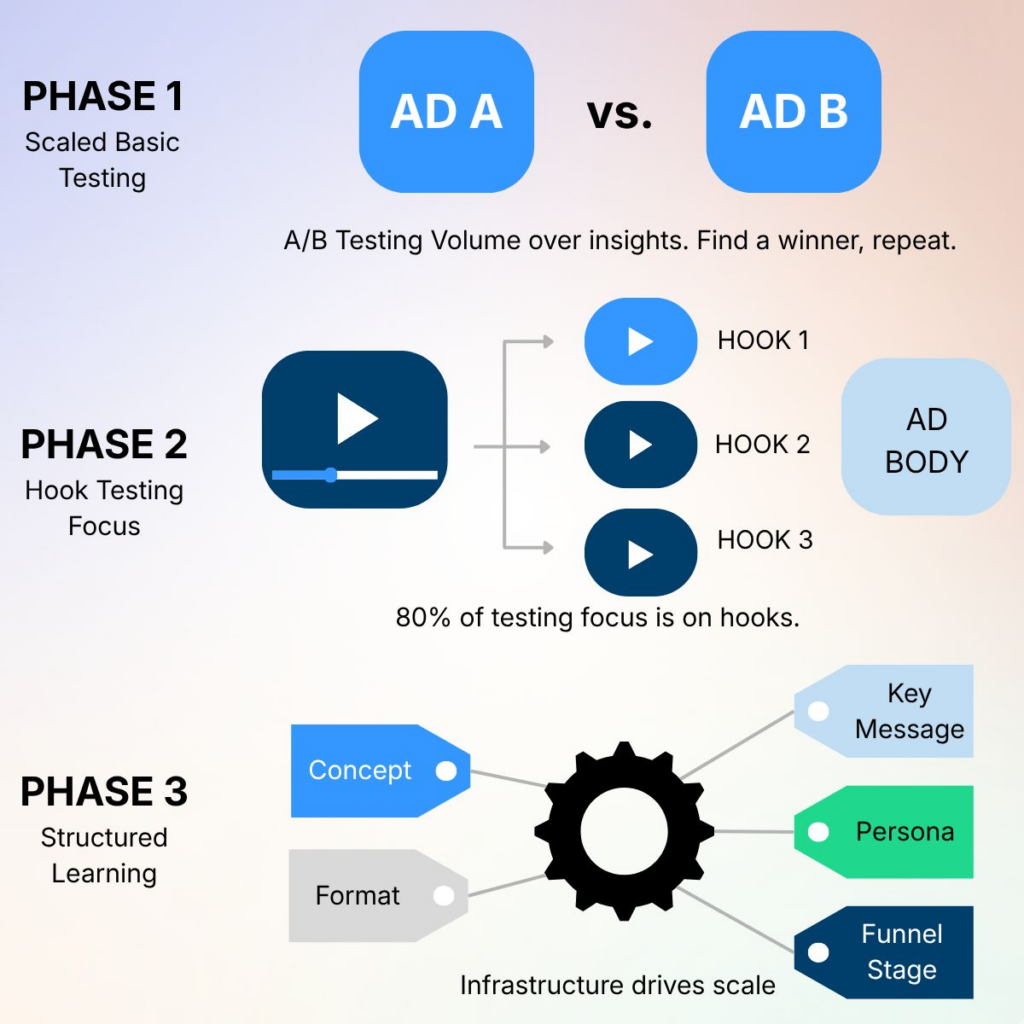
What is a creative system in paid social?
A creative system is an operating model that combines four things: a tagging taxonomy applied to every ad before launch, a high volume of varied creative produced on a weekly cadence, structured weekly performance reviews against the taxonomy, and a re-briefing process that turns learnings into the next round of variants. The output isn’t a list of top-performing ads. It’s a map of which creative patterns drive performance for which buyers—patterns that can be reproduced, varied, and scaled across the account.
The 5 attributes to tag every paid social ad against
Before any ad goes live, it gets tagged across five attributes.
- Concept: Whether the ad is leading with a problem, a solution, curiosity, or desire. Two ads can sell the same product but approach the buyer from entirely different psychological angles, and the angle that resonates is rarely obvious until the data is in.
- Format: Static image, short-form video, carousel. Format isn’t a creative choice; it’s a delivery mechanism that interacts with the algorithm and the user differently for different audiences.
- Message: Feature and benefit, social proof, objection-handling, education. This is what the ad is actually trying to communicate. Two ads with the same hook can be delivering completely different messages, and tagging that distinction is what lets the data show which messages convert.
- Persona: Not the broad audience definition the brief was written against, but the specific micro-persona the ad is built for. A home services brand isn’t selling to one buyer. It’s selling to first-time homeowners, families in older homes, retirees downsizing, landlords managing rentals. Each of those buyers responds to different creative. Tagging by persona is what makes that visible in the data.
- Funnel stage: Whether the ad is being built for someone unaware of the problem, aware of the problem but not the solution, aware of the solution but evaluating products, or aware of the product and choosing between competitors. Funnel stage shapes what an ad needs to do, and conflating stages is one of the most common reasons creative tests come back inconclusive.
Why tagging creative is what turns testing into learning
Without these tags, the output of a creative test is a list of which individual ads won. That’s useful for the next 30 days and then the list is stale. With the tags, the output is something different: a map of which patterns are working. Solution-oriented hooks in carousel format for one persona at one funnel stage. Education-led video for a different persona at a different stage. The performance isn’t tied to the specific ad that won, it’s tied to a pattern that can be reproduced, varied, and scaled.
That’s the difference between testing and learning. Testing tells you which ad worked last month. Learning tells you what to build next month, and the month after, and the month after that.
How much creative volume, variety, and testing velocity does paid social require?
A taxonomy doesn’t work without enough creative running through it. Three operational requirements have to be in place.
- Volume. The algorithm needs enough variants to find patterns, and the taxonomy needs enough variants tagged in each cell to make patterns statistically meaningful. Teams getting real lift from this approach are launching eight to ten new variants per week, consistently.
- Variety. Variants have to span the taxonomy—different concepts, different formats, different personas, different funnel stages—or the data only tells you what’s working in the narrow slice you tested.
- Velocity. Learnings from this week’s data have to inform what’s built next week. A wins-and-losses review on a quarterly cadence doesn’t move fast enough for the algorithm or the market. Weekly review, with re-briefing baked into the same week, is the minimum cadence for a system that compounds.
Creative testing fuels lead growth and efficiency
Silverback rebuilt the creative operating model for a brand whose Meta performance had plateaued. Creative was being produced monthly. The algorithm wasn’t getting enough variety to exit the learning phase. We moved them to 10 new variants per week tagged against the taxonomy, weekly performance reviews, and a re-briefing process that turned learnings into the next week’s creative.
Leads grew 719%. Cost per lead dropped 43%. Nothing about the targeting or bidding changed. The lift came entirely from rebuilding how creative was produced, tagged, and learned from.
The question worth asking
Most teams are asking what they should test next. That question produces a backlog of one-off tests and no compounding insight. The better question is what they’re trying to learn, and whether they have the infrastructure to actually learn it. Brands that build the system are pulling ahead. Brands that don’t are running hook tests and watching performance flatten.