Blog: What a Study of $1.3B in Meta Ad Spend Reveals About Paid Social Creative Strategy



A recent study analyzing $1.3 billion in Meta ad spend found something that challenges how most marketers think about paid social: performance isn’t driven by creative intuition — it’s driven by creative output.
Table of Contents

For years, brands have chased the perfect ad. The perfect script. The perfect visual. The perfect campaign idea. But the data tells a different story. The brands that win on paid social today aren’t necessarily the ones with the most polished ideas. They’re the ones testing the most ideas.
This insight reflects a fundamental shift in how paid social works. Platforms like Meta have become increasingly dependent on machine learning systems that rely heavily on creative signals. Instead of marketers deciding which ads will work best for specific audiences, algorithms are constantly testing and learning which creative combinations resonate most with users.
But for the algorithm to learn, it needs options. And that’s where many brands fall short.
How Do Paid Social Algorithms Use Creative Signals?
Modern paid social advertising platforms are designed to identify patterns between audiences and creative. When campaigns launch with a wide range of messaging, visual styles, and formats, the platform can quickly determine which combinations generate engagement and conversions.
However, when brands launch campaigns with only a handful of ads, paid social algorithms (like Meta Andromeda) have very little information to work with. It becomes much harder for the platform to discover what actually resonates with different segments of the audience.
This is why creative has become the most important lever in paid social performance.
It’s not just the message being delivered to users. Creative is now the primary signal the algorithm uses to decide who sees your ads and how often they’re shown. When marketers increase creative diversity, they effectively give the platform more opportunities to match the right message with the right person.
And when that happens, performance improves.
Why Do Most Paid Social Ads Underperform?
One of the most important lessons from large-scale creative performance data is that winning ads are surprisingly rare.
Across millions of ads analyzed in studies like the recent Meta dataset, a small percentage of creative variations tend to drive a disproportionate share of results. The majority of ads perform average or below average.
For marketers accustomed to traditional advertising, this can feel counterintuitive. Historically, campaigns were built around a single big creative idea that was expected to carry performance.
But performance marketing works differently.
Rather than trying to predict the winning ad in advance, successful teams build systems that allow them to discover winners through testing. The process becomes less about creative intuition and more about structured experimentation.
In other words, the goal isn’t to guess the right ad. The goal is to find it faster than your competitors.
Creative Diversity Is Where the Real Insights Come From
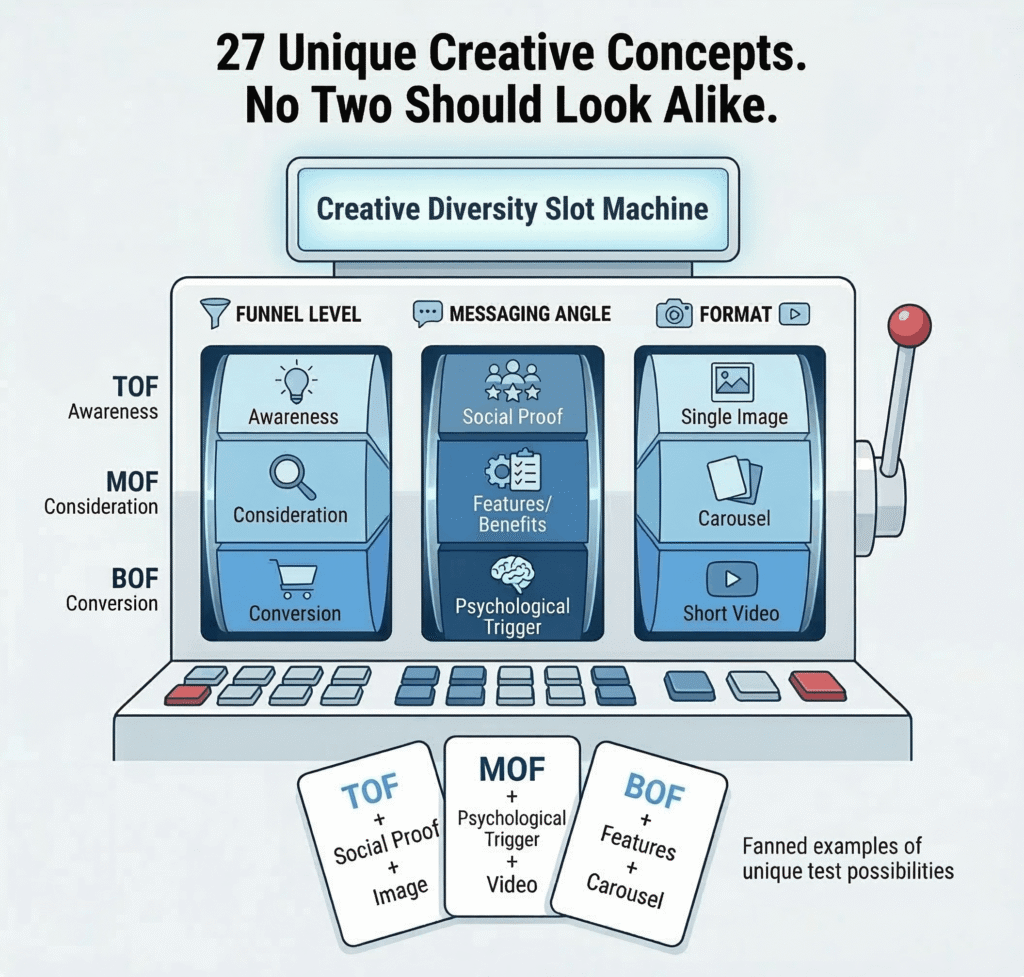
Increasing creative volume alone isn’t enough. The most effective testing programs also emphasize creative diversity.
Too often, brands interpret creative testing as producing slightly different versions of the same ad. A new color treatment. A different headline. A slightly modified video edit.
But these minor variations rarely generate meaningful insights.
Real performance breakthroughs tend to happen when brands explore fundamentally different ways of communicating their value. One creative angle might focus on a customer pain point, while another highlights social proof. A third might rely on humor or storytelling. Another may use UGC-style ads — user-generated content that feels native to the feed and builds trust through authenticity rather than production value.
Each of these approaches speaks to different motivations, emotional triggers and creative tastes within the audience. Because those motivations vary widely across consumers, it’s nearly impossible to predict which angle will resonate most strongly without testing.
Creative diversity allows marketers to explore those differences at scale.
From Individual Ads to Scalable Creative Systems
Another shift happening in high-performing paid social programs is the move away from chasing individual winning ads.
Even the most successful ad will eventually hit ad creative fatigue. Audiences stop responding. Platforms change. New competitors enter the market.
Instead of focusing on one-off creative hits, leading teams focus on identifying creative systems—repeatable combinations of messaging, visuals, and formats that consistently perform well.
“A creative system is a repeatable combination of a proven audience insight, a clear messaging angle, a recognizable visual pattern, and an ad format that consistently drives performance.”
For example, a strong insight about customer motivation might evolve into multiple ads that explore the same concept through different hooks, visual treatments, or storytelling styles. Each variation reinforces the same core idea while giving the algorithm additional signals to optimize against.
Over time, this approach creates a scalable framework for creative production. Instead of constantly reinventing campaigns from scratch, brands can expand on what they already know works.
What Makes a High-Performing Paid Social Creative Strategy?
While creative testing velocity is critical, it shouldn’t be mistaken for random experimentation. The most successful creative programs begin with research designed to uncover the motivations behind customer behavior.
This research often includes analyzing customer sentiment, identifying purchase triggers and barriers, studying competitive messaging, and understanding broader economic or cultural trends influencing buying decisions.
Insights are sourced rapidly—through review-mining, AI-assisted audience surveys, and competitive & market analysis—and allow marketers to build creative around specific audience motivations, not generic messaging.
From there, those ideas can be translated into multiple visual and messaging directions. Each concept becomes a hypothesis that can be tested against others in market. Over time, the results of those experiments reveal which narratives resonate most strongly.
This process transforms creative development from a subjective exercise into a data-informed system.
What’s Holding Back Your Paid Social Creative Performance?
Ironically, the biggest obstacle to this approach isn’t budget or platform complexity.
It’s approval process.
Many organizations still operate with creative workflows designed for traditional advertising. Campaigns move through lengthy approval cycles, with teams striving to perfect every detail before launch.
But this mindset can be counterproductive in performance marketing environments where success depends on experimentation and speed.
If winning ads only emerge from a small percentage of creative, then scale and testing velocity become critical advantages. When approval processes slow down production, brands dramatically reduce the number of ideas they can test. Meanwhile, competitors who embrace faster, more iterative creative workflows are constantly discovering new performance insights.
In this environment, perfection can become the enemy of performance.
Interestingly, some of the highest-performing ads today are not the most polished ones. They’re often lo-fi, creator-style videos or simple concepts that feel authentic and native to the platform. These formats can be produced quickly and tested rapidly, allowing teams to learn far faster than traditional production cycles allow.
The Competitive Advantage of Creative Velocity
As paid social platforms continue evolving, the role of creative will only grow more important.
But the advantage will not come from predicting the perfect campaign. It will come from building systems that generate ideas quickly, test them aggressively, and scale the insights that emerge.
Brands that embrace creative diversity and testing velocity will create a learning engine that compounds over time. Those that remain stuck in slow approval cycles and low creative output may never uncover the messages that truly resonate — and in an environment where creative is the difference between average and exceptional performance, that gap can grow quickly.
Building a scalable performance creative system requires four things:
- Research-driven creative strategy grounded in real audience motivations, not generic messaging assumptions
- Creative diversity that explores fundamentally different angles, not just minor variations of the same idea
- High-volume testing that gives the algorithm enough signals to identify winning patterns
- Rapid iteration cycles that prioritize speed and learning over perfection
FAQ
How many ad creatives should I test on Meta?

There's no universal number, but most brands significantly under-test. You need enough creative volume for the algorithm to identify patterns — for Silverback clients, this typically means 10-20+ active variations across diverse messaging angles and formats, refreshed weekly as creative winners are identified or creative fatigue sets in.
What is creative fatigue in paid social?
Creative fatigue occurs when an audience has seen your ads enough times that engagement drops and costs rise. It shows up as declining hook rates, rising CPMs, and falling click-through rates. Monitoring reach-to-frequency ratios helps identify fatigue early, signaling when new creative concepts are needed to maintain performance.
Why do most paid social ads underperform?
Most paid social ads underperform because winning creative is statistically rare — only a small fraction of ads drive a disproportionate share of results. This isn't a creative failure; it's the math of testing. Success comes from running enough experiments to surface winners, not from predicting them in advance.
What is a creative system in paid social advertising?
A creative system is a repeatable combination of a proven audience insight, a clear messaging angle, a recognizable visual pattern, and a consistently performing ad format. Rather than chasing one-off winning ads, high-performing teams build and scale these systems — expanding a single insight into dozens of variations across formats and audiences.