Blog: Meta Andromeda Broke Your Paid Social Playbook


Key Takeaways
Meta’s new AI-driven retrieval system rewrote how ads are chosen, ranked, and optimized. Most marketers haven’t caught up yet.
- 1. The Old Meta Ads Playbook Is Broken
Campaigns broke after the July 2025 Andromeda update, leading to rising CPAs and dipping CTRs. The old strategy of manual segmentation is penalized because it starves the machine of necessary data. - 2. Meta is Now an AI Recommendation Engine
The system was rebuilt around the Generative Engine Model (GEM). It moved from an ad auction to an AI-powered recommendation engine. This means creative is the new targeting; the system learns by observing creative response, not audience lists. - 3. Simplify to Teach the Algorithm
Adopt the rule: structure for learning, not control. Simplify to scale by using fewer campaigns and broader targets. This gives the AI the room and data it needs to identify patterns and achieve scale.
Table of Contents

When Meta rolled out its Andromeda update globally in July 2025, most advertisers didn’t notice anything at first. Campaigns kept running; dashboards looked fine.
Then, quietly, things started to break.
CPAs crept up. CTRs dipped. Learning phases dragged on. Accounts that had performed consistently for years began to look like strangers to their own data.
And for a simple reason: the ad serving engine under the hood had changed completely.
What looked like a few soft weeks of performance wasn’t a seasonal dip, it was Meta retiring the system your entire advertising strategy was built on.
How Meta’s Andromeda Update Changed the Ad Retrieval System
Andromeda wasn’t another round of Advantage+ automation. It was part of a larger overhaul — Meta’s new Generative Engine Model (GEM) — a machine-learning framework that governs how ads are retrieved, ranked, and rendered across its platforms.
At the heart of that shift sits Andromeda, the retrieval layer that decides which ads even make it to the starting line for an impression.
In other words: Meta didn’t just tweak how ads are shown, it rebuilt the system that decides what’s eligible to be shown at all. (Source: Meta Engineering)
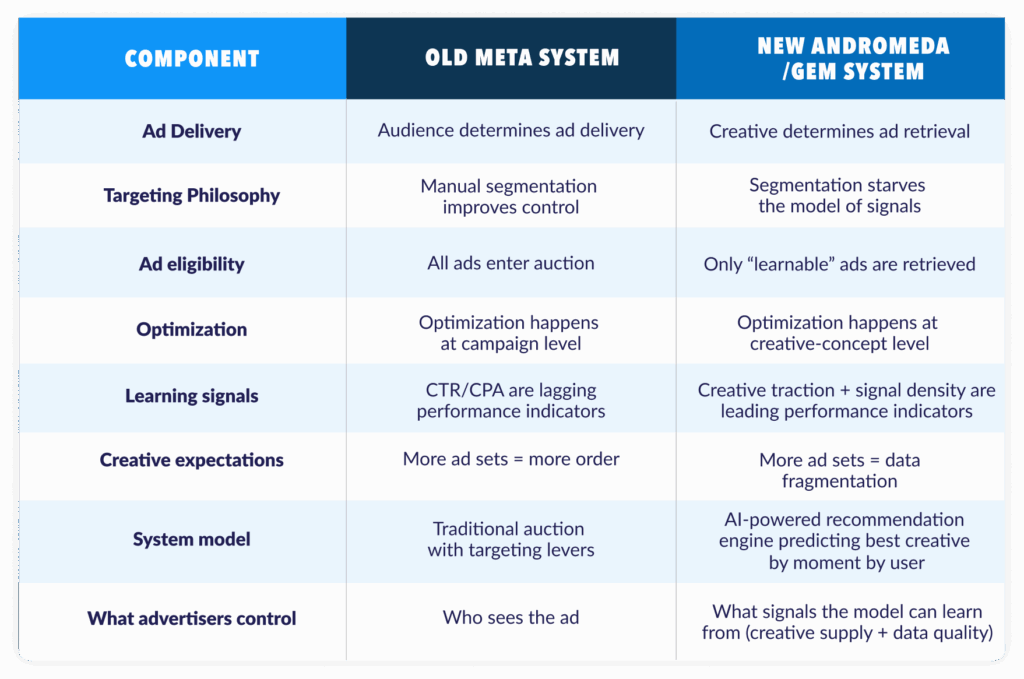
The hard part? Andromeda’s changes are nearly invisible in the interface. Your ads keep delivering, your metrics keep updating — but the underlying logic that decides who sees what has changed. By the time performance tells you something’s wrong, the algorithm is already weeks ahead of you.
Every campaign structure, targeting approach, and testing framework built for the old ad serving logic is now running on outdated assumptions. Advertisers who kept operating with narrow, manually segmented campaigns are seeing performance fall off a cliff.
What Meta’s GEM Model Is and How It Powers Andromeda
What’s “GEM”?
GEM stands for Generative Engine Model, Meta’s new end-to-end framework for how ads are retrieved, ranked, and rendered.
Think of it as the brain that powers Andromeda.
Instead of relying on preset audience targeting, GEM uses massive behavioral and creative data to predict which creative + audience + moment combination will drive the best result — in real time.
Andromeda is the retrieval layer inside GEM. It’s responsible for surfacing the right creative options for the model to evaluate.
The shift: Meta’s ad system now behaves less like an ad auction and more like an AI-powered recommendation engine.
Why it matters: Marketers can’t “tell” Meta who to target anymore, they have to teach the algorithm what success looks like through creative variety, clean signals, and campaign structure.
Why Traditional Meta Targeting and Segmentation No Longer Work
The old Meta game rewarded manual control: tight audiences, single-theme ad sets, and a handful of tested creatives.
That approach worked when Meta’s system relied on explicit targeting levers to find people. But under Andromeda, the system now learns by observing how people respond to creative, not just who they are. It prioritizes campaigns that give it room to test, compare, and learn from a wide range of creative and behavioral signals. (Source: Meta Engineering Blog — Sequence Learning in Ads Ranking)
Segmentation doesn’t just starve the machine, it traps your spend in tiny dead-end learning loops the algorithm can’t escape from. When budgets are spread thin across dozens of narrowly defined ad sets, each one gathers too little data for the algorithm to learn what actually drives results.
Performance drops aren’t because Meta is “broken.” They happen because the system now rewards creative breadth and signal quality — and most advertisers are still feeding it fragments of each.
How to Structure Meta Campaigns for Andromeda’s Machine-Learning Engine
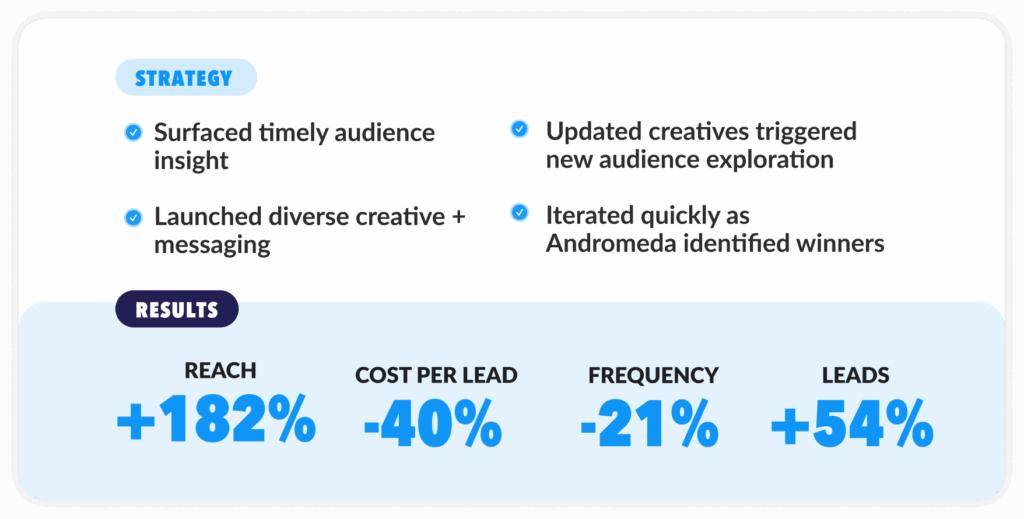
The brands that adapted fastest did one thing: they rewired their campaign structures around machine learning, not manual control.
Instead of trying to outsmart the algorithm, they started feeding it better inputs.
Here’s what that looks in practice:
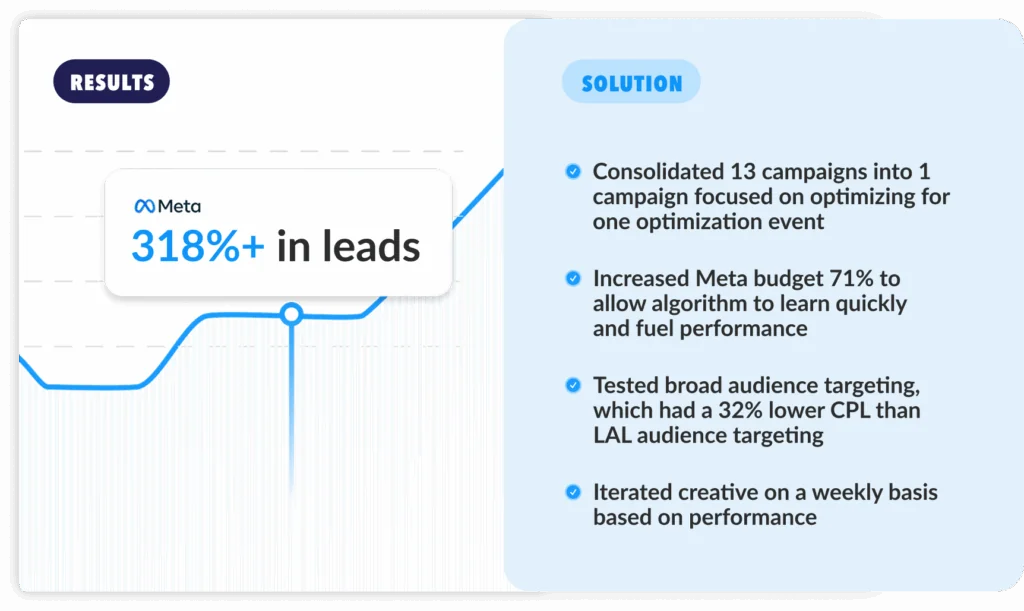
- Fewer campaigns, broader targets. The system performs best when it has room to explore. Broader targeting gives the retrieval engine enough reach to identify patterns and match creative to intent on its own.
- More creative concepts per ad set. Each new concept gives the algorithm another data point to learn from. Diversity isn’t just about volume, it’s about giving Meta’s model a range of formats, messages, and visual styles that speak to different micro-personas within your audience.
- Clean, complete signal data. The model learns faster when it receives consistent feedback. Accurate conversion tracking, server-side events, and strong first-party data are now the fuel that drive optimization.
- Continuous refresh cycles. Fresh creative keeps the system learning. Without new inputs, Andromeda’s retrieval model runs out of fresh signals to learn from, and delivery efficiency plateaus. New concepts reintroduce variation that helps the algorithm maintain discovery and performance momentum.
The job of the advertiser isn’t to steer the system anymore. Your job is to build the conditions where Meta can learn, adapt, and scale faster than a human could.
Why Creative Volume and Variation Drive Performance Under Andromeda
Andromeda exposed a truth that’s been building for years: your creative library is your targeting.
In this new system, performance depends on the breadth, quality, and evolution of your creative inputs. The algorithm doesn’t just decide who to show your ads to — it decides which creative ideas deserve to keep showing up.
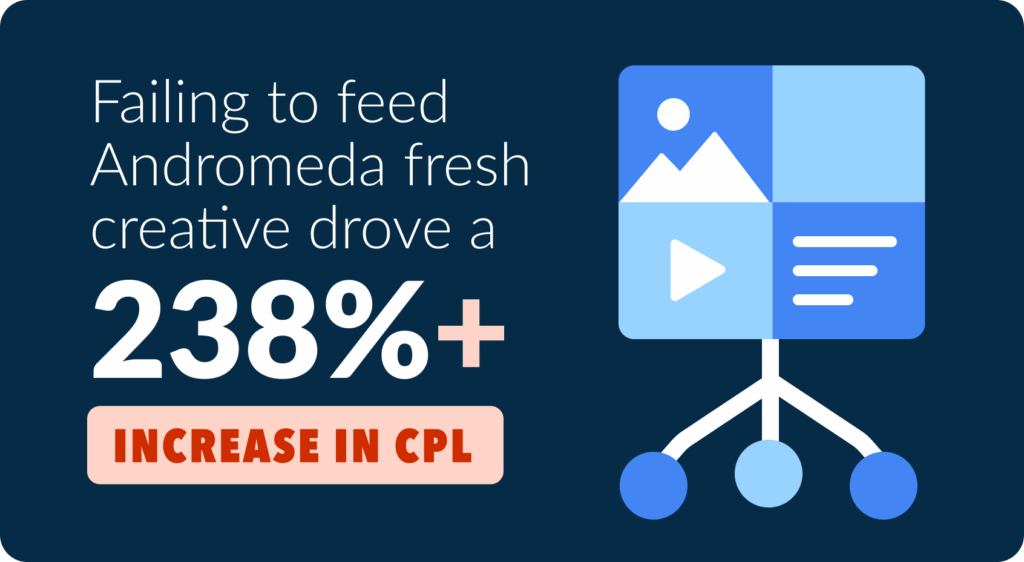
That changes the job of a marketing team. You’re no longer managing campaigns, you’re managing a creative feedback loop. The gap between teams that refresh creative frequently and those that don’t is widening fast. When creative stagnates, Andromeda stops exploring, and once exploration stalls, costs rise quickly and rarely recover on their own.
Here’s how leading teams approach it:
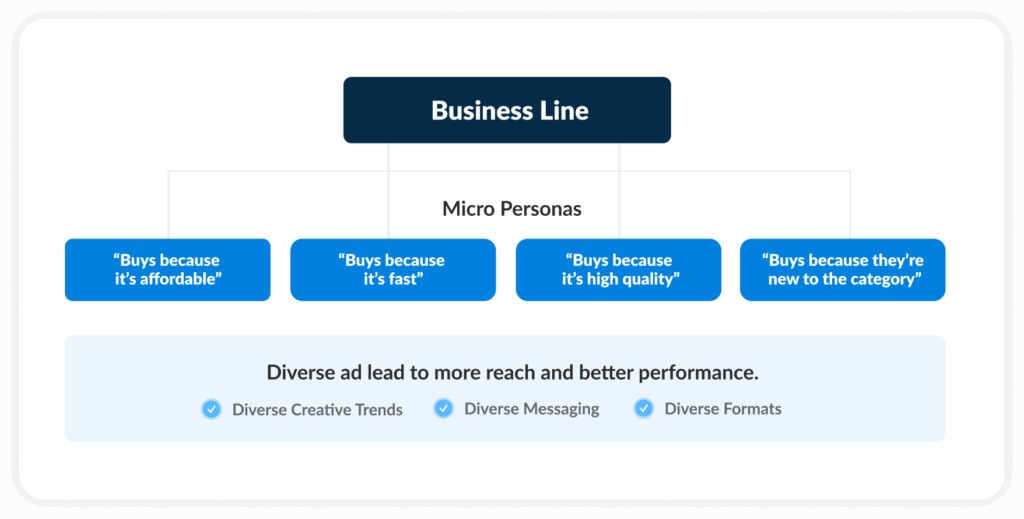
- Creative variation as fuel. Build creative around defined micro-personas, then make sure each lane has real diversity: different visuals, formats, and trend cues. This gives Andromeda the signal range it needs to learn how each persona engages and uncover new pockets of efficiency you’d never segment manually.
- Creative analysis as a process. The best teams systematically monitor creative performance the way they monitor campaign data. They track early signals of performance (rising engagement, expanding reach) to spot concepts gaining traction — and watch for signals of fatigue (rising frequency, declining CTR) to know when the algorithm has learned all it can and it’s time to refresh.
- Refreshing and reinforcing momentum. Once fatigue sets in, the goal isn’t just to swap in something new; it’s to keep the algorithm learning. When performance stabilizes or frequency rises, new creative reintroduces variety so Andromeda can continue exploring what works. Similarly, when you see a concept gaining traction, double down with related variants — new executions that build on the same story, offer, or hook. This balance between refreshing fatigued assets and expanding on high-performing ones keeps learning active and efficiency improving.
If your team only produces a handful of new ads each month, you’re not feeding the machine enough to sustain performance. Every business line reaches multiple micro-personas—people who buy the same product for different reasons. Andromeda can only learn those differences when you supply creative that speaks to each sub-audience.
Which KPIs Matter Most in Meta’s Andromeda Retrieval System
Andromeda changed how Meta decides what works — so the KPIs you use to judge performance have to change, too.
CTR, CPA, and ROAS still have value, but they’re rear-view-mirror metrics. If you’re using them as your primary signal, you’re already late. In Andromeda, lagging indicators degrade quickly, which means you need to look upstream. The real questions that determine performance now are:
- How fast are new ads finding traction?
- How long do top creatives hold up before performance drops?
- Are you giving Meta clean data on what counts as a real result?
Those are the signals that show whether your ad creative and structure are helping the system learn, or holding it back.
What a High-Performing Meta Account Looks Like After Andromeda
Winning in the Andromeda era means rebuilding your Meta strategy around learning, not control.
The brands adapting fastest share a few common traits:
- Simplified structure: One campaign per objective, broad targeting, and multiple creative concepts per ad set so the system has room to learn.
- Keep Creative Fresh: New assets launched every 2-4 weeks to keep signals fresh and performance stable.
- Clean data: Full-funnel tracking and server-side events that tell Meta what real outcomes look like.
- Continuous testing: Iterative creative loops instead of one-off experiments.
The common thread? Everything feeds the machine.
The gap between brands that teach the system well and brands that don’t will widen every month. Marketers who adapt early will lock in cheaper learning, stronger retrieval, and compounding efficiency.
Those who wait won’t just fall behind, they’ll be rebuilding from a deficit the algorithm keeps deepening.
FAQs
What is Meta Andromeda, and how did it change ad retrieval?

Meta Andromeda is the new retrieval layer inside Meta’s Generative Engine Model (GEM). It's the core system that decides which ads are even eligible to be shown for an impression. This update fundamentally rebuilt the ad serving engine, moving it from an ad auction model to an AI-powered recommendation engine.
How is Meta’s Generative Engine Model (GEM) different from prior automation?
GEM stands for Generative Engine Model, Meta’s new end-to-end machine-learning framework for ad retrieval, ranking, and rendering. Unlike the old system that relied on preset audience targeting, GEM uses massive behavioral and creative data to predict the best creative + audience + moment combination in real-time.
Why did my CPA spike after the July 2025 Meta update?
When the Andromeda update rolled out globally in July 2025, performance declines were common. If you kept running narrow, manually segmented campaigns (the "old playbook"), the new retrieval logic penalized this strategy. This led to rising CPAs and declining CTRs because the system was starved for data to learn what drives results.
What is the most important change for my campaign structure after Andromeda?
The single most critical change is to shift your campaign structure to enable machine learning. Consolidate ad sets and use broader targets. The goal is to give the retrieval engine enough reach and data points (via creative variety) for the algorithm to identify patterns and match creative to intent on its own.
How does this change the role of the advertiser in creative strategy?
Your role has shifted from a manual campaign manager to a creative feedback loop manager. You must now teach the algorithm what success looks like through creative variety and signal quality. This involves systematically monitoring creative performance, spotting concepts gaining traction, and refreshing/reinforcing momentum to keep the algorithm learning